Capabilities
Governance, at the level where enterprise risk actually lives.
Trustethica governs AI at the contextual use-case level, where business purpose, operational behaviour, and enterprise liability intersect.
Why This Matters
That is the gap Trustethica was built to close.

Main Capabilities
Five capabilities. One operating model.
Capability 01
Purpose Drift Detection
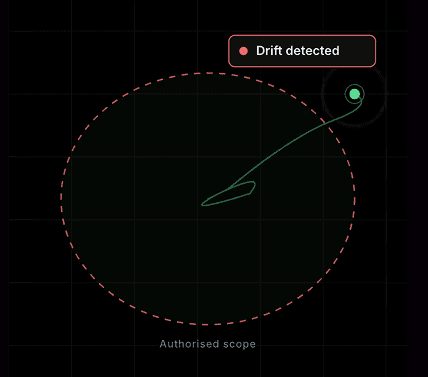
Detect when AI behaviour departs from its authorised business purpose.
The Problem
The underlying model still performs. The agent still executes. The access controls still hold. The logs are clean. The purpose has changed. A customer support assistant configured to answer product questions is increasingly relied on for financial guidance. A research agent registered to summarise regulatory filings for internal counsel is now used by relationship managers ahead of client meetings. Same underlying model, same permissions, same outputs. Materially different decision context, materially different consequence, materially different risk.
Operational Outcomes
• Scope deviation surfaced at runtime, not at next review • Severity classified against the declared business purpose • Use case attributed to its named business owner • Escalation routed through structured workflows
Governance Outcomes
Continuous oversight evidence between governance review cycles.
Capability 02
AI × Enterprise Risk Line of Sight
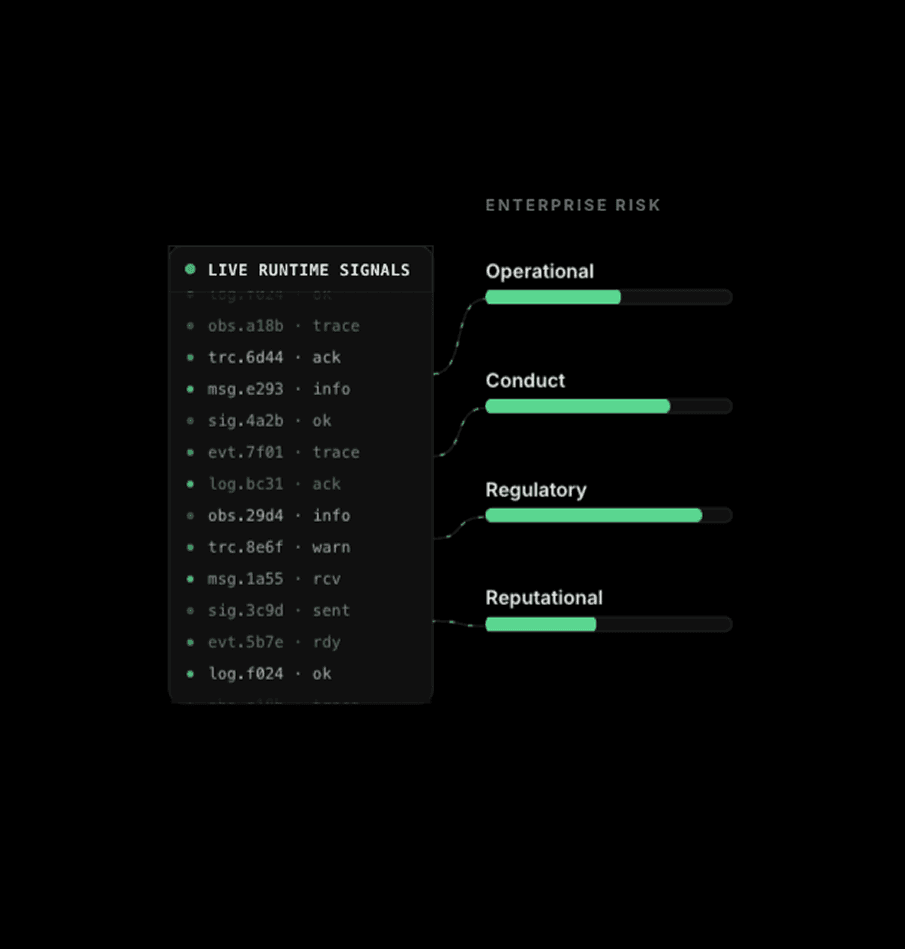
Translate live AI behaviour into the enterprise risk language boards, CROs, and audit teams already use.
The Problem
AI systems generate technical signals. Boards and C-Suites govern operational, conduct, regulatory, and reputational risk. The translation between those two layers is mostly manual today, if it even happens at all.
Operational Outcomes
• AI behaviour translated into your enterprise risk categories • Portfolio-wide visibility across governed AI use cases • Risk classification aligned to existing enterprise frameworks • Structured escalation paths into existing accountability lines
Governance Outcomes
Boards and C-Suite govern AI risk in the taxonomy they already use.
Capability 03
Runtime Enforcement
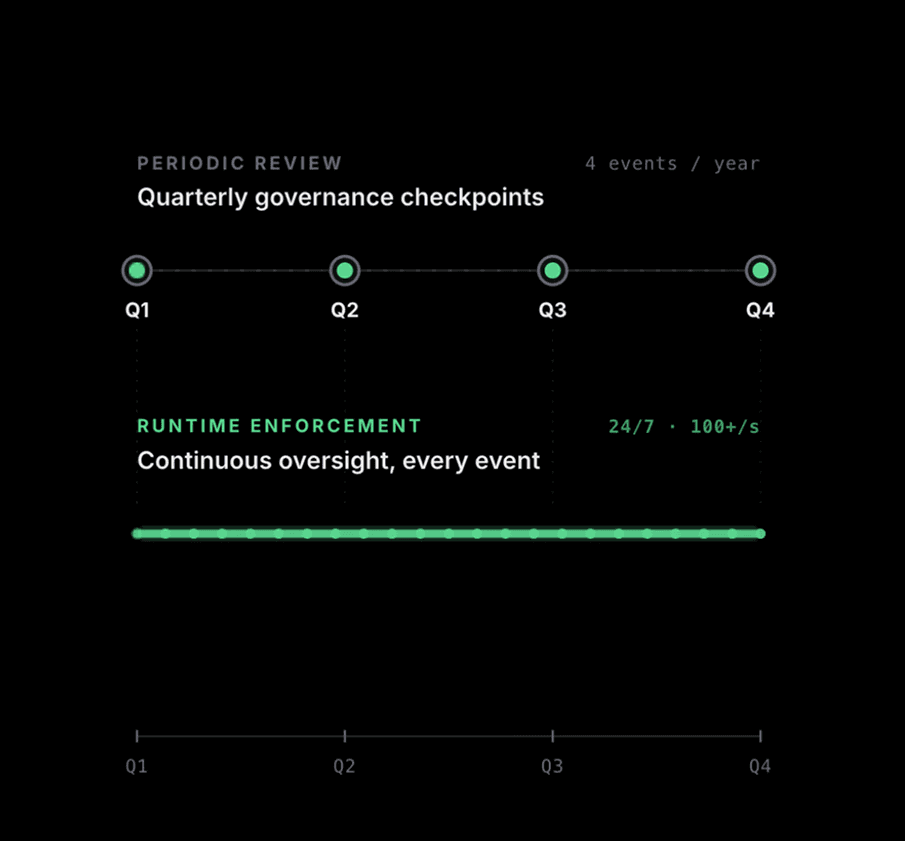
Continuous governance between deployment, review, and attestation cycles.
The Problem
Traditional risk management frameworks operate periodically. Enterprise AI does not. Prompts evolve, workflows expand, integrations shift, usage patterns change. Static reviews cannot govern dynamic operational behaviour.
Operational Outcomes
• Continuous evaluation of governed AI use cases • Runtime enforcement against authorised boundaries • Governance actions timestamped at the moment they occur • Escalation routed to accountable owners
Governance Outcomes
Governance blind spots between formal review cycles close.
Capability 04
Defensible Audit Evidence
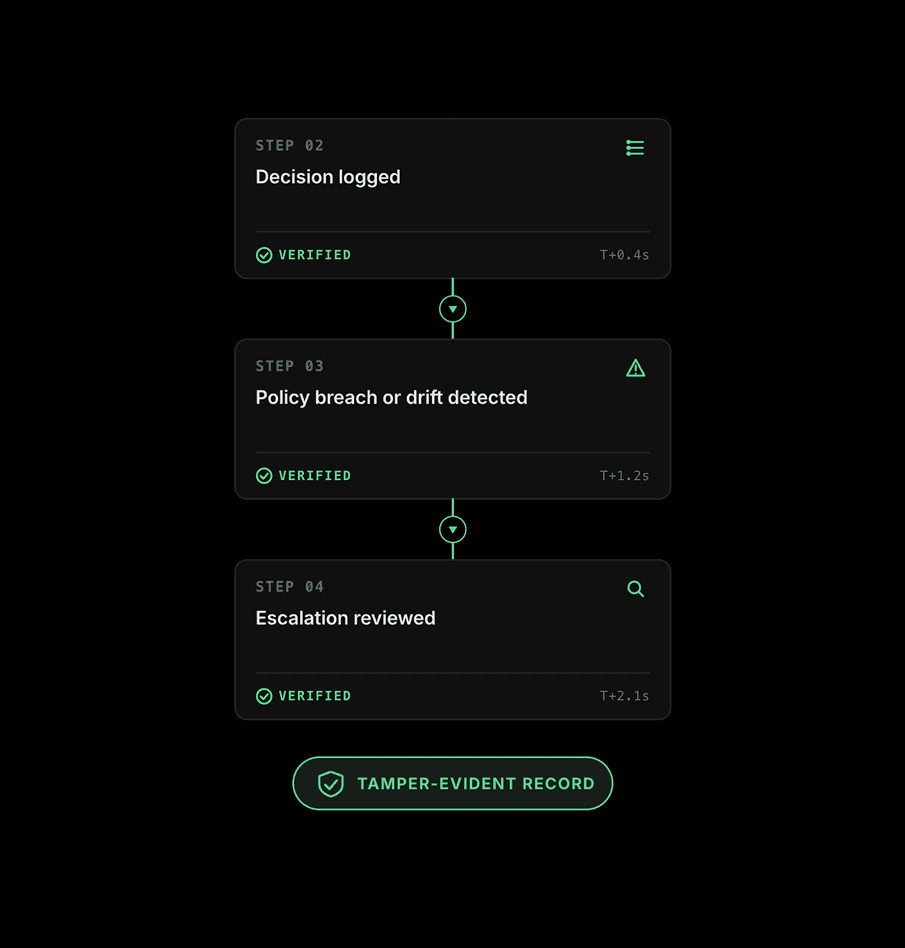
Governance records structured for audit, examination, and regulatory scrutiny.
The Problem
Most organisations reconstruct AI governance evidence retrospectively and often under pressure. Lifecycle documentation captures intent while runtime systems capture behaviour. Without a governance layer connecting the two, audit readiness becomes fragmented and difficult to defend.
Operational Outcomes
• Timestamped governance records with decision rationale • Cryptographically linked audit trails • Export-ready governance dossiers • Evidence aligned to internal audit, examiner, and regulator expectations
Governance Outcomes
Continuous audit readiness, not retrospective reconstruction.
Capability 05
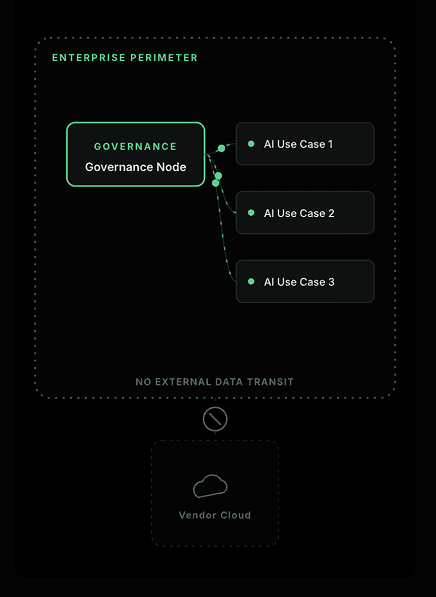
Zero-Transit Architecture
Governance infrastructure deployed inside the enterprise perimeter. Your data never leaves.
The Problem
For regulated enterprises, governance data is itself a material risk asset. External vendor-cloud dependencies introduce procurement friction, processor obligations, custody-chain concerns, and additional regulatory exposure.
Operational Outcomes
• Deployment inside customer-controlled infrastructure • No external governance-data transit • Support for cloud, sovereign region, or on-premises deployment • Procurement and vendor risk overhead reduced
Governance Outcomes
Sovereign custody of governance records, from onboarding to audit export.